
What if the very sensitivity you fear will hold your son back is actually his greatest untapped strength? You recognize his high intellectual potential, yet you watch him retreat behind a closed door, increasingly resistant to your guidance. It’s exhausting to feel that every attempt to help results in a power struggle or deeper isolation. You may have already tried traditional therapy, only to find it feels like treating a “disease” rather than addressing his specific developmental needs. Finding a specialized mentor for sensitive teenage boys offers a different path. It moves beyond clinical labels to meet him where he is, providing a bridge between his current paralysis and his future potential.
In this guide, you will discover why bright, intense boys require a unique mentorship model to build lasting resilience and self-motivation. We will examine how a grounded, non-judgmental partnership can stop the cycle of “failure to launch” and restore balance to your home dynamics. By shifting from a “fixing” mindset to one of strategic development, you can help your son navigate the transition to young adulthood with clarity and confidence. The goal isn’t just to get him through the week; it’s to equip him for the long game of life.
Key Takeaways
- Reframe sensitivity as a high-performance engine rather than a pathology to better support your son’s unique emotional and intellectual makeup.
- Discover why a specialized mentor for sensitive teenage boys is more effective than traditional therapy for building the autonomy required for a successful transition to adulthood.
- Learn the difference between external compliance and internal resilience, helping your son move from reactive overthinking to decisive action.
- Understand the strategic necessity of a long-term, high-touch engagement to break through the paralysis often seen in bright, intense young men.
- Identify the specific ways a professional mentorship can de-escalate household conflict and restore a healthy parent-child relationship.
The ‘Intense’ Son: Why Sensitive Teenage Boys Need a Specialized Mentorship Model
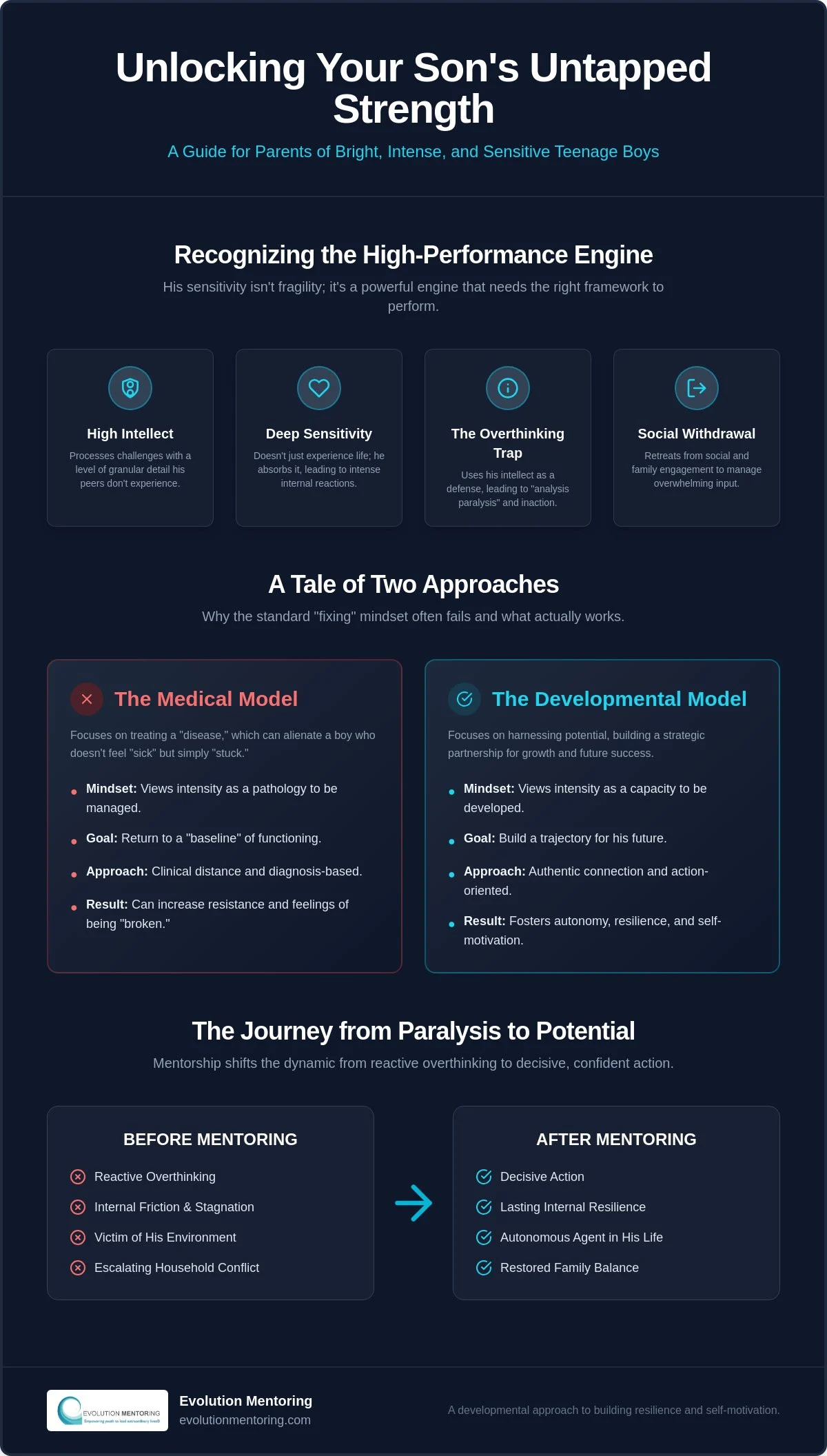
Sensitivity in a young man is often mischaracterized as fragility. In reality, it is a high-performance emotional and intellectual engine that, left uncalibrated, can lead to significant internal friction. For the bright and intense boy, every social interaction or academic challenge is processed with a level of granular detail that his peers simply don’t experience. This depth is a profound asset; yet, without a strategic framework, it frequently results in overthinking and social withdrawal. Parents often see the potential but find themselves locked out by a son who has retreated into his own mind. They feel the weight of his stagnation. A specialized mentor for sensitive teenage boys acts as a strategic partner in building an internal operating system for life.
Traditional clinical models often struggle to address this specific demographic because they are designed to treat disorders. If your son doesn’t have a “disease” but simply lacks a “direction,” a medicalized approach can feel like trying to fix a car that isn’t broken but is merely stuck in the mud. This is where the broader field of youth mentoring provides a more effective foundation. It shifts the focus from pathology to potential.
Moving Beyond the Medical Model
The “Adolescence Is Not A Disease” philosophy shift is fundamental to successful growth. When we stop viewing a boy’s intensity as a symptom to be managed, we can start viewing it as a capacity to be developed. Clinical intervention focuses on returning to a “baseline” of functioning. Developmental mentoring focuses on the trajectory of his future. It moves the conversation from “What is wrong with you?” to “How do we harness who you are?” This distinction is vital for boys who are suspicious of being “fixed.”
The Overthinking Trap
Gifted boys possess a unique ability to use their high intellect as a defense mechanism. They can talk themselves out of any risk before they even take the first step. This “analysis paralysis” creates a stalled transition where the boy remains safe but stagnant. An action-oriented coach interrupts this cycle. Movement is the only cure for rumination. By prioritizing tangible progress, the mentor helps the boy prove to himself that his sensitivity is a superpower. It’s not a liability. He learns to lead with his strengths rather than hide behind them.
The Role of a Male Mentor: Bridging the Gap Between Sensitivity and Resilience
For a bright young man, the world often feels loud, chaotic, and demanding. When he is also sensitive, he doesn’t just experience life; he absorbs it. This intensity often leads to a reactive state where he is constantly defensive or withdrawn. A mentor for sensitive teenage boys provides a necessary “Wise Mentor” archetype. Instead of focusing on what is broken, this mentor acts as a clear mirror. He reflects the boy’s latent potential and helps him see past the immediate emotional storm. This shift is critical for building internal resilience. True resilience isn’t about hardening a boy’s heart. It’s about moving from being a victim of his environment to being an autonomous agent within it.
The Benefits of Mentoring for Youth are well-documented, but for the intense boy, the impact is specifically transformative. He needs to see that his depth is compatible with strength. He needs a guide who remains unphased by his outbursts or his silence. When a mentor has “seen it all” across decades of experience, he doesn’t react with the same anxiety a parent might feel. This steady presence creates a safe container for the boy to test his boundaries and explore his identity without fear of judgment.
Authentic Connection vs. Clinical Distance
Sensitive boys have a high “BS detector.” They often resist the clinical distance of traditional therapy, perceiving it as a place for the “sick” or the “broken.” A mentor positions himself as a trusted advisor. This relationship is built on mutual respect and shared goals rather than a diagnosis. We focus on the long game. We aren’t just looking to get him through high school. We are preparing him for the challenges he will face at 25. If you are ready to explore this proactive approach, you can schedule a consultation to discuss your son’s specific needs.
Essential Life Skills for the Intense Boy
Growth requires more than just talk; it requires a toolkit for navigating a complex world. We focus on developing emotional regulation that doesn’t require suppressing sensitivity. It’s about mastery, not denial. This includes:
- Strategic Mindset: Learning to turn overthinking into a high-level problem-solving asset.
- Social Navigation: Helping sensitive boys find their “tribe” and build meaningful relationships without losing their core identity.
- Autonomy: Moving from parental compliance or defiance to self-directed, motivated action.
Transitioning to Autonomy: The Evolution Mentoring Approach
Meaningful change is not a sprint. It requires a sustained, strategic commitment to override behavioral patterns that have often been years in the making. This is why a six-month intensive engagement is the baseline for substantive growth. When a boy is bright and sensitive, he can easily “perform” for an hour once a week. He knows what adults want to hear. Real transformation occurs in the spaces between scheduled meetings. A specialized mentor for sensitive teenage boys provides a high-touch model that includes 24/7 access, allowing for intervention during the actual “storms” of daily life. This real-time support ensures that new skills are applied when the stakes are highest, not just discussed in the safety of a quiet room.
This intensive approach is specifically designed to prevent the “failure to launch” cycle. Many families find themselves stuck in a pattern of hovering and high-conflict because they fear their son lacks the resilience to survive on his own. By building a boy’s autonomy, we simultaneously reduce the stress on the entire family system. The positive impact of mentors extends beyond the individual; it allows parents to return to their primary role as a source of love and support rather than acting as a constant manager or disciplinarian. When the son takes ownership of his path, the household dynamic shifts from one of friction to one of mutual respect.
Beyond the Weekly Session
The traditional “clinical hour” is often insufficient for intense adolescents. Life doesn’t happen in fifty-minute increments. Real-world coaching builds skills in the environments where they are actually needed: at school, in social circles, and during the transition to young adulthood. We move past theoretical discussions. We focus on the practical application of emotional regulation and strategic decision-making. If he can’t use the tool when he’s frustrated on a Tuesday night, the tool is useless. Evolution Mentoring and Life Coaching ensures he can.
Taking the Next Step
Determining if your son is a fit for Evolution Mentoring and Life Coaching requires an honest assessment of his current trajectory and your family’s goals. If you are seeking a partner who is uncompromising in their commitment to your son’s long-term success, it may be time for a different conversation. You can schedule a consultation with Jeff Leiken to discuss your son’s unique situation and explore how a structured, high-touch mentorship can facilitate his transition to a motivated, resilient adulthood.
Charting a New Path Toward Autonomy
The transition from a stalled adolescence to a motivated young adulthood requires more than just patience; it requires a strategic framework that respects your son’s intensity. We’ve seen that sensitivity is not a liability to be managed but a high-performance engine that needs the right calibration. By moving away from a medicalized “fixing” model and toward developmental coaching, you provide your son with the internal resilience he needs to navigate the world with confidence. Choosing a mentor for sensitive teenage boys ensures that your son has a trusted advisor who understands the unique intersection of being bright, intense, and gifted. It’s about playing the long game for his success at 25 and beyond.
With 30 years of global experience across four continents, Jeff Leiken specializes in the specific profiles of young men who are currently “shutting the door” on their potential. Based in Mill Valley and available globally through virtual engagement, Evolution Mentoring and Life Coaching provides the high-touch support necessary to break the cycle of failure to launch. You don’t have to navigate this storm alone. If you’re ready to shift your family dynamic from constant conflict to mutual respect, Apply for a Private Consultation with Jeff Leiken today. Your son’s potential is still there. It’s time to give him the tools to unlock it.
Frequently Asked Questions
How is a mentor different from a therapist for my sensitive son?
A mentor for sensitive teenage boys focuses on developmental growth and strategic life skills rather than clinical diagnosis or “fixing” a disorder. While therapy often looks backward to heal past trauma, mentoring looks forward to build future autonomy. It is the difference between a medical intervention and a high-level partnership designed to optimize a boy’s internal operating system. We don’t view your son as a patient with a disease, but as a young man who needs a strategic direction.
My son is very bright but lacks motivation; can mentoring help?
Mentoring is specifically designed for bright, intense boys who have used their intellect to talk themselves out of taking risks. This “stalled transition” isn’t a lack of ability; it is a lack of a clear, actionable direction. We work to turn overthinking into strategic problem-solving. By setting concrete goals and fostering self-motivation, we help them move from a state of paralysis to one of decisive action. The goal is to bridge the gap between his high potential and his daily performance.
What does “high-touch” mentoring actually look like in practice?
High-touch mentoring means the relationship exists in the real world, not just a clinical office. It includes 24/7 access for the mentee, allowing for guidance during actual moments of stress or decision-making. This model recognizes that growth doesn’t happen in fifty-minute increments once a week. Instead, a mentor for sensitive teenage boys provides a steady, non-judgmental presence that can intervene in real-time “storms” to reinforce new behavioral patterns as they occur. It is a premium, intensive commitment to his long-term success.
Is mentoring effective for boys who are resistant to talking about their feelings?
Mentoring is often more effective for resistant boys because it avoids the “face-to-face” clinical pressure that often triggers their defenses. We use an action-oriented approach that focuses on what he wants to achieve rather than how he “feels” about a problem. By building trust through shared objectives and practical success, the boy becomes more open to deeper conversations over time. He sees the mentor as a strategic ally rather than an authority figure trying to fix him. This shift in perspective is what allows for genuine, lasting change.