
What if the very intelligence that should be your teenager’s greatest asset has actually become their primary obstacle? It’s a painful irony when a child who can debate complex philosophy or master intricate code cannot seem to turn in a simple homework assignment. You’ve likely spent years navigating the disconnect between their high IQ and their low grades, feeling the weight of “failure to launch” anxiety while every conversation about the future ends in social friction. You’re right to feel that traditional tutoring or clinical therapy hasn’t quite reached them. Specialized coaching for bright underachieving teens offers a necessary alternative by moving beyond academic nagging to address the internal world of a gifted mind.
We understand that these “intense” teens don’t need more pressure; they need a different kind of partnership. This article explores why standard interventions often fall short and how a mentoring-based approach builds the resilience required to turn stalled potential into purposeful autonomy. You’ll learn how to move away from constant overthinking and toward a life where your teen takes genuine ownership of their future. By the end, you’ll see a clear path toward reducing family conflict and helping your child find a sense of direction that feels both authentic and earned.
Key Takeaways
- Understand why high intelligence often creates analysis paralysis and a profound fear of failure in gifted adolescents.
- Learn the critical distinction between clinical therapy and the growth-oriented model of coaching for bright underachieving teens.
- Discover how the presence of a Wise Mentor facilitates maturity in sensitive, intense teens who resist traditional interventions.
- Identify the specific timeframe and structural support required to move from a state of stalled transition to genuine autonomy.
- See how Parent Coaching Consultations reduce family conflict by aligning the home environment with your teen’s developmental needs.
The Paradox of the Bright Underachiever: Why IQ Isn’t Enough
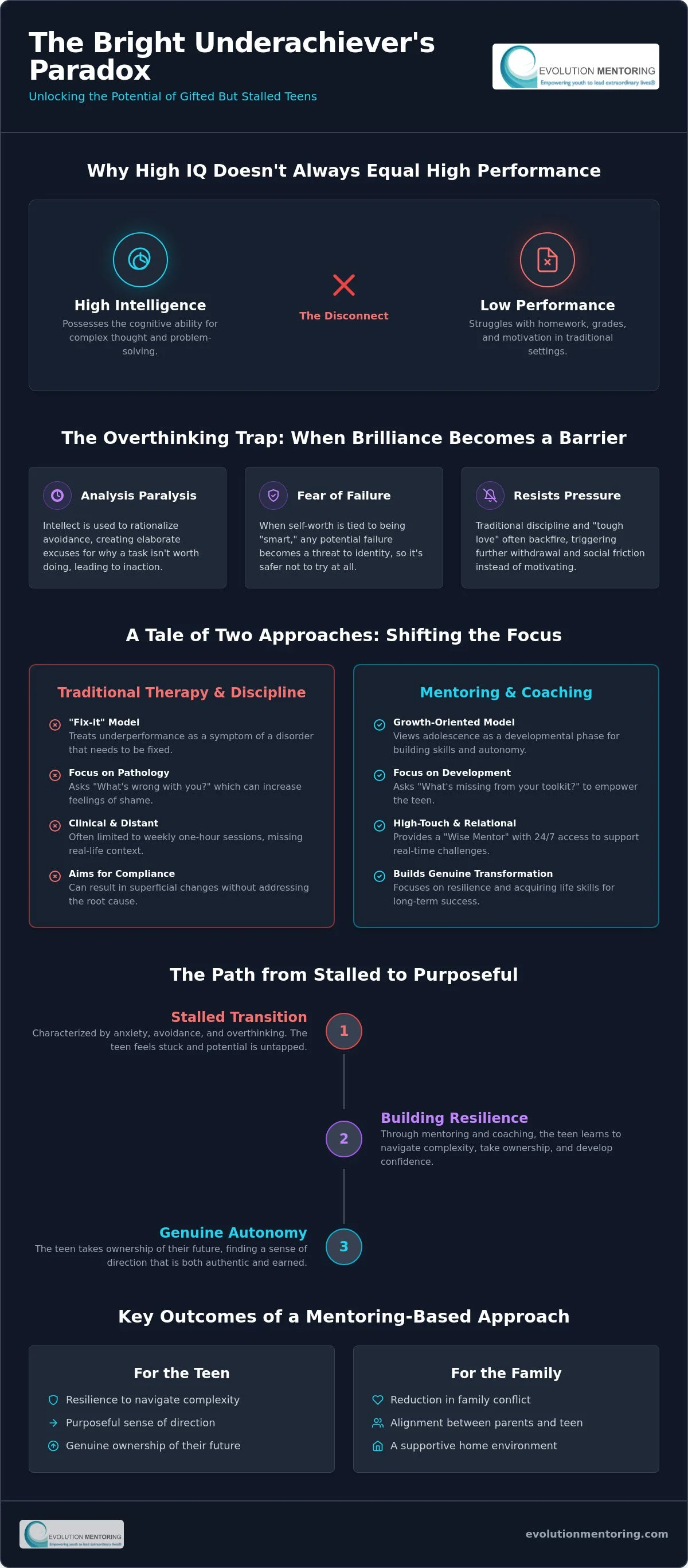
The assumption that high intelligence naturally leads to high performance is one of the most persistent myths in modern education. In reality, intellectual capacity often outstrips emotional resilience. When we examine What is an underachiever?, we see a teen who possesses the cognitive hardware for success but lacks the integrated software to execute it. This gap creates a profound internal conflict. They know they’re capable; their parents know they’re capable; yet the grades and motivation simply aren’t there. Traditional school environments, designed for linear progress and compliance, rarely engage the “intense” adolescent brain that craves depth and purpose. We must remember that adolescence is not a disease to be cured, but a critical developmental phase for building the autonomy needed for adulthood.
The Overthinking Trap: When Brilliance Becomes a Barrier
High intelligence can be a double edged sword. For many, it manifests as analysis paralysis. These teens use their intellect to rationalize avoidance, creating elaborate excuses for why a task isn’t worth their effort. This is often rooted in a fixed mindset. If they believe their value is tied to being “smart,” then failing at a difficult task is a threat to their identity. To protect that label, they stop trying. It’s a strategic retreat disguised as laziness. Effective coaching for bright underachieving teens addresses this psychological bottleneck by shifting the focus from being gifted to being resilient.
Why Traditional Discipline Often Backfires
When parents see a brilliant child stalling, the natural instinct is to increase pressure. However, traditional discipline often triggers further withdrawal. In high stakes environments like the San Francisco Bay Area and Marin County, the pressure to perform is suffocating. Tough love without a foundational mentoring connection feels like an attack rather than support. These teens don’t need more rules; they need a Wise Mentor who understands the nuances of their intensity. If you’re seeing this disconnect in your home, it may be time to schedule a consultation to explore a growth oriented path forward.
Mentoring vs. Therapy: A Growth-Oriented Approach to Underachievement
Traditional clinical therapy often operates on a “fix-it” model, treating underperformance as a symptom of a disorder. While clinical intervention is vital for crisis management, it often fails to engage the specific psychological aspects of underachievement found in gifted adolescents. Evolution Mentoring and Life Coaching shifts the focus from pathology to development. Instead of asking what’s wrong, we ask what’s missing in their toolkit for maturity. This growth-oriented model is a core component of effective coaching for bright underachieving teens. It prioritizes the “long game,” where we value the acquisition of essential life skills over the temporary satisfaction of a single improved test score. If your child has already cycled through multiple therapists without seeing a shift in their behavior, you might explore Alternatives to Therapy for Teens that prioritize this developmental lens. We aren’t interested in superficial compliance. We want genuine transformation.
The “Wise Mentor” Model for Gifted Adolescents
Bright, sensitive boys frequently lack a male role model who speaks their language without being condescending. A mentor acts as a linguistic translator, bridging the gap between a teen’s internal world and their parents’ expectations. Unlike a weekly one-hour clinical session, this model provides high-touch support and 24/7 access during the moments when real-life challenges occur. It’s about being there in the storm. This level of intensive coaching for bright underachieving teens is what distinguishes a trusted advisor from a distant clinician. This presence allows us to challenge a teen’s excuses in real-time, holding them to a higher standard of maturity while maintaining a deep professional bond.
Building Resilience Through Intentionality
We don’t view resilience as mere “toughness” or the ability to endure suffering. True resilience is the capacity to navigate complexity with a steady, non-judgmental confidence. It’s about taking ownership when things go wrong rather than retreating into overthinking. Evolution Mentoring and Life Coaching is a personalized coaching service designed for bright adolescents to build autonomy. By focusing on systemic family dynamics, we ensure the teen isn’t working in a vacuum. If you’re ready to move beyond quick fixes, you can reach out to discuss a long-term strategy for your family. Growth takes time. We help them earn it.
The Path to Autonomy: Transitioning from Stalled to Purposeful
Genuine transformation isn’t a weekend event. It’s a deliberate, six month process that requires both time and consistency to take root in a teen’s identity. If you’ve spent years wondering Why Bright Children Underperform, you’ve likely realized that intelligence alone cannot bridge the gap to adulthood. Our specialized coaching for bright underachieving teens focuses on this developmental bridge. We also utilize Parent Coaching Consultations to align the home environment with the teen’s emerging maturity. Without this systemic alignment, even the most profound breakthroughs can be lost to old family patterns. For those in the “failure to launch” phase, we provide the rigid structure young adults need to move from a state of paralysis into purposeful action.
Essential Life Skills for the Modern Adolescent
We focus on building the specific internal architecture that traditional schools often overlook. When a teen masters these skills, the academic and social underperformance often resolves itself as a natural byproduct of their increased maturity. Key areas of focus include:
- Emotional Regulation: Learning to sit with the discomfort of a difficult task without retreating into digital distractions.
- Social Relationship Management: Moving beyond social friction to build meaningful, adult-level connections.
- Self-Advocacy: Developing the confidence to ask for what they need from teachers, employers, and parents without falling into entitlement.
Next Steps: Moving from Anxiety to Clarity
The transition from a stalled life to one of autonomy begins with a single, strategic conversation. It’s time to move beyond the cycle of “failure to launch” anxiety and toward a clear, expert-guided path. You’ve been the “calm in the storm” for your child for a long time; now, it’s time to take proactive action that challenges them to grow. The first step is to assess the family system and identify the specific bottlenecks holding your teen back. You can schedule a consultation to discuss your teen’s unique situation and begin the work of turning their stalled potential into a future of genuine ownership.
Turning Stalled Potential into Purposeful Action
The gap between who your teen is and who they’re capable of becoming won’t close on its own. We’ve explored how high intelligence can actually hinder progress when it isn’t paired with emotional resilience, often leading to a paralysis that traditional clinical models fail to reach. Real change requires a fundamental shift from addressing behavioral symptoms to building a lasting foundation of autonomy. With 30 years of professional experience, Evolution Mentoring provides a specialized focus on intense and gifted profiles, offering a growth-oriented alternative to the standard therapeutic approach. This is the essence of effective coaching for bright underachieving teens: providing a structure that respects their brilliance while demanding their maturity.
It’s about playing the long game for your child’s future. If you’re ready to move from a state of constant family friction to one of clarity and purpose, the first step is a strategic conversation to assess your family’s unique dynamics. You don’t have to navigate this transition alone. Book a Strategic Consultation for Your Teen to begin the process of reclaiming their momentum. Your child’s potential is still there; it’s simply waiting for the right partnership to take flight.
Frequently Asked Questions
Is coaching for bright underachieving teens better than therapy?
Mentoring isn’t necessarily “better” than therapy, but it serves a distinct developmental purpose. While clinical therapy often focuses on diagnosing and treating pathology, coaching for bright underachieving teens is a growth oriented model designed to build future autonomy. If your teen is intellectually capable but lacks the integrated resilience to execute their potential, a mentoring approach is often more effective than traditional clinical models that focus on what is “wrong” rather than what is missing.
How do I know if my teen is a “bright underachiever” or just unmotivated?
A bright underachiever typically possesses high cognitive ability but lacks the emotional software to manage the pressure that comes with it. If your child can engage in sophisticated, complex conversations yet stalls on basic organizational tasks, they aren’t merely unmotivated. They’re often caught in a cycle of overthinking and a profound fear of failure. This distinction is crucial because treating a lack of resilience as a lack of effort usually leads to increased resistance and deep family conflict.
What is the role of the parent in the mentoring process?
Parents are essential partners in the systemic shift toward a teen’s maturity. Through Parent Coaching Consultations, we help you align the home environment with the growth your teen is experiencing in their one on one mentoring sessions. When parents learn to move from a cycle of constant friction to one of supportive accountability, the teen finds the structural space they need to take ownership of their life. We act as a linguistic translator to ensure everyone is moving toward the same goal.
Can mentoring help my teen if they are already seeing a therapist?
Mentoring can absolutely complement existing therapeutic work. While a therapist might address internal emotional blockages or past trauma, coaching for bright underachieving teens focuses on real world application and building the specific life skills needed for daily autonomy. We often work alongside other professionals to ensure a cohesive support system for the family. This high touch model provides a consistent, grounding presence that a weekly clinical hour simply cannot offer on its own.