
Traditional therapy often fails the brightest young minds because it treats a developmental stall as if it’s a clinical disorder. You’ve likely watched your child cycle through clinicians and career counselors, only to see them retreat further into overthinking and paralysis. It’s exhausting to witness such immense potential remain dormant while the “failure to launch” narrative takes hold in your home. You know they’re capable, yet the bridge to independence seems to have vanished. Specialized coaching for young adults finding direction offers a path forward that traditional clinical models simply aren’t designed to provide.
In this article, you’ll discover why bright, sensitive individuals require a different architectural approach to autonomy. We’ll explore how a specialized mentoring model facilitates a genuine transition into self-assured adulthood. You’ll learn the difference between managing symptoms and building the resilience required for a true launch. We will examine the limits of the medical model and outline the specific life skills necessary for your child to move from dependence to a clear, self-driven purpose.
Key Takeaways
- Reframe the “Failure to Launch” experience as a developmental stall rather than a clinical disorder or a lack of ambition.
- Understand why specialized coaching for young adults finding direction succeeds where traditional therapy often stalls by focusing on autonomy instead of pathology.
- Learn how a mentor acts as a linguistic translator to bridge the communication gap between parents and children, reducing family friction.
- Identify the three pillars of genuine growth: building internal resilience, mastering essential life skills, and developing social confidence.
- Discover why bright, sensitive minds require a high-touch, premium alternative to the standard one-hour clinical session to achieve a lasting launch.
Why Traditional Paths Fail Bright Young Adults Finding Direction
If your child is highly intelligent yet completely stationary, you aren’t dealing with a lack of drive. You’re dealing with a stalled transition. This specific period of emerging adulthood is notoriously difficult for those with intense, sensitive temperaments. Traditional therapy often treats this stagnation as a clinical disorder to be managed. We view it as a developmental milestone that requires a different map. Specialized coaching for young adults finding direction provides that map by focusing on growth rather than pathology.
Evolution Mentoring is a strategic partnership designed to bridge the gap between potential and action. It moves beyond the “disease model” of traditional support to address the structural needs of a maturing individual. For many families, coaching for young adults finding direction is the missing piece that turns clinical insight into tangible movement. Traditional paths often fail because:
- They focus on pathology rather than developmental potential.
- They lack the high-touch accountability needed for real-world action.
- They treat the individual in isolation, ignoring the systemic family dynamics that keep them tethered.
The Overthinking Trap: Why Intelligence Doesn’t Equal Direction
Bright young adults are experts at using their intelligence as a sophisticated defense mechanism. They can rationalize their stagnation with such precision that it feels like a logical choice. They mistake deep contemplation for progress. In reality, they’re stuck in a loop that never leads to a decision. Productive planning requires a tolerance for imperfection that many high-IQ individuals lack; they would rather be perfectly stationary than imperfectly mobile.
When Therapy Reaches a Plateau
Many families arrive at a point where therapy has reached its natural limit. They’ve spent years processing the past, yet the present remains static. Therapy is retrospective by design. It’s about understanding and healing. To move forward, the focus must shift to the logistics of maturity. You must move from processing history to architecting a future. This requires a partner willing to have difficult conversations about the behaviors that prevent genuine autonomy.
Comparing Coaching Models for Stalled Transitions
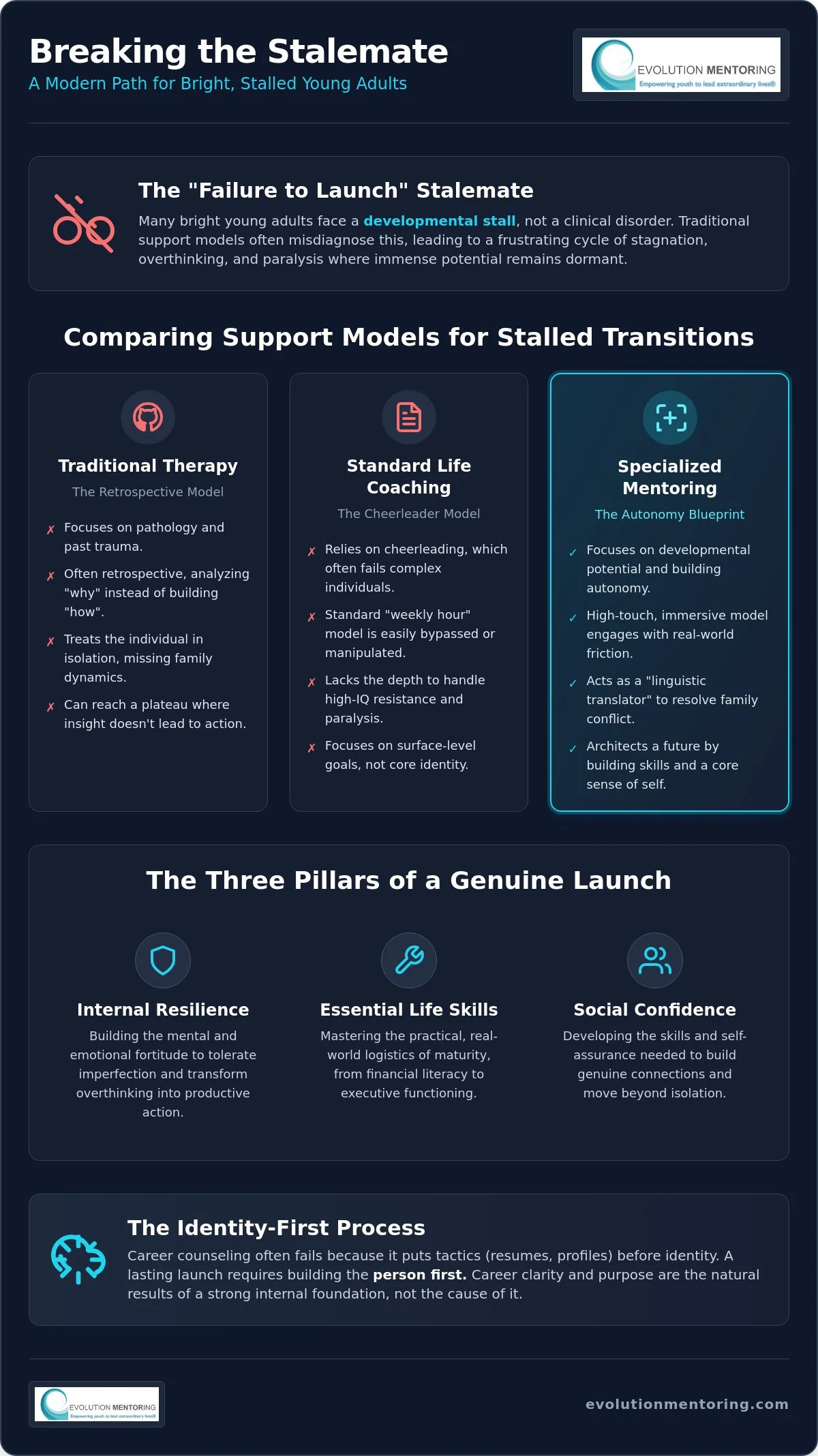
Choosing the right support is a high-stakes decision that determines whether a young person moves forward or continues to tread water. Clinical therapy focuses primarily on what is broken, while standard life coaching often relies on cheerleading that fails to move the needle for complex, intense individuals. While the benefits of coaching for young adults are well-documented for general population needs, those facing a stalled transition require a more nuanced approach. You need a mentor for young adults who understands that intensity is a trait to be harnessed, not a symptom to be suppressed or medicated away.
A mentor serves as a linguistic translator between generations. When parents speak from a place of logic or concern, the young adult often hears judgment or pressure, which only fuels their paralysis. We bridge this gap by translating these conflicting perspectives into a shared language of growth and accountability. This specialized coaching for young adults finding direction acknowledges the high-stress reality of family stagnation while providing a steady, non-judgmental presence. If your current support system feels like it has reached a plateau, it’s often because the model itself lacks the depth to handle the complexity of a bright mind in crisis. You might find it helpful to explore a more intensive partnership to break this cycle.
Life Coaching vs. Evolution Mentoring
Most life coaching follows a “weekly hour” model that is too easily bypassed by a bright, resistant young adult. Evolution Mentoring is an immersive, high-touch experience that goes beyond simple goal setting. We don’t just talk about the life they want; we engage with the friction of their daily reality in real time. It’s the difference between a distant consultant and a trusted advisor who is present when the actual work of maturity happens.
The Role of Specialized Career Counseling
Many families turn to career counselors to fix the “direction” problem by focusing on LinkedIn profiles and resume formatting. However, these tactical skills fail if the young adult lacks a core sense of identity. Finding direction is an identity-first process. Without a grounded sense of self, a resume is just a list of obligations they don’t actually want to fulfill. We focus on building the person first, knowing that career clarity is the natural byproduct of a solid internal foundation.
Moving from Stagnation to Autonomy with Evolution Mentoring
Transitioning from a state of paralysis to one of active autonomy requires more than just encouragement; it demands a structural shift in how a young person engages with the world. The Evolution Mentoring framework is built on three essential pillars: resilience, life skills, and social confidence. Jeff Leiken brings 30 years of global experience across four continents to families in Mill Valley, San Francisco, and New York. This depth of expertise allows us to provide a “calm in the storm” for families living in high-pressure environments like Marin County or Beverly Hills. When the household dynamic has become a cycle of frustration and withdrawal, we step in as a steadying force. We invite you to schedule a consultation to determine if this high-touch partnership is the right catalyst for your family.
Building Resilience in a “Sensitive” Brain
Bright, intense individuals often experience the world with a heightened sensitivity that can lead to emotional overload. We provide specific tools to manage this intensity without resorting to clinical intervention or labels that suggest the individual is “broken.” Our approach utilizes a sophisticated blend of tough love and deep empathy. We hold the young adult to a high standard of accountability while validating the depth of their experience. This balance is critical. If you only offer empathy, they remain stuck; if you only offer pressure, they retreat. By combining both, we create the friction necessary for growth.
The Path to Lasting Autonomy
The end goal of coaching for young adults finding direction isn’t simply to secure a job or a degree. It’s to ensure the individual has a complete command of their own life. We focus on a transformative 6-month path that moves them from a state of dependence to self-assured autonomy. This is the “long game.” We aren’t interested in temporary compliance or quick fixes that fall apart the moment the pressure increases. Instead, we architect a foundation of maturity that allows them to navigate the complexities of adulthood with resilience and intentionality. They don’t just find a direction; they develop the internal compass to stay the course.
Architecting the Path to Autonomy
Navigating a stalled transition requires moving beyond clinical labels and addressing the unique developmental needs of a bright, sensitive mind. We’ve explored how traditional therapy often plateaus because it focuses on the past rather than the logistics of the future. By reframing “failure to launch” as a developmental stall, you can begin the work of building genuine resilience and social confidence. Effective coaching for young adults finding direction provides the structural support necessary to turn overthinking into decisive action. It’s about movement, not just understanding.
With 30 years of professional experience across four continents, Jeff Leiken specializes in the specific dynamics of bright, intense, and sensitive individuals. We understand the unique pressures faced by families in Mill Valley, San Francisco, and New York; we provide a grounded, expert presence to navigate these high-stress environments. This is the “long game” of maturity. Our approach is designed to move your child from a state of dependence to a position of command over their own life.
If you’re ready to shift from a cycle of stagnation to a narrative of progress, we invite you to Schedule a Consultation with Evolution Mentoring. Real change is possible when you have the right partner. It is time to build the bridge to their independence.
Frequently Asked Questions
How is coaching for young adults different from traditional therapy?
Coaching for young adults finding direction differs from therapy by focusing on future-oriented autonomy rather than retrospective healing. While therapy is essential for processing past trauma or clinical disorders, mentoring addresses the structural gaps in maturity and life skills. It’s a shift from asking “why” to asking “how,” providing the high-touch accountability required to bridge the gap between potential and action.
What are the signs that my young adult child is “stalled” rather than just lazy?
Stalling is characterized by an “overthinking trap” where high intelligence is used to rationalize inaction. Unlike laziness, which is a simple lack of effort, a stalled transition is rooted in developmental paralysis and the fear of making an imperfect choice. If your child is bright and sensitive but remains stationary despite their potential, they aren’t lazy; they’re stuck in a cycle of analytical overthinking.
How long does it typically take to see a change in direction and motivation?
Lasting transformation typically follows a six-month framework designed to build resilience and master essential life skills. While you may notice subtle shifts in communication or perspective within the first few weeks, genuine autonomy is a cumulative process. We focus on the long game because quick fixes rarely survive the realities of adult pressure. Mastery requires time, intentionality, and consistent engagement.
Can mentoring help if my child is resistant to getting help?
Resistance often stems from a fear of being judged or treated like a clinical patient. Mentoring bypasses this by positioning the relationship as a strategic partnership rather than a medical intervention. We speak the language of the intense, sensitive individual, acting as a translator between their perspective and yours. When a young adult feels understood rather than “managed,” their resistance naturally begins to dissolve.